
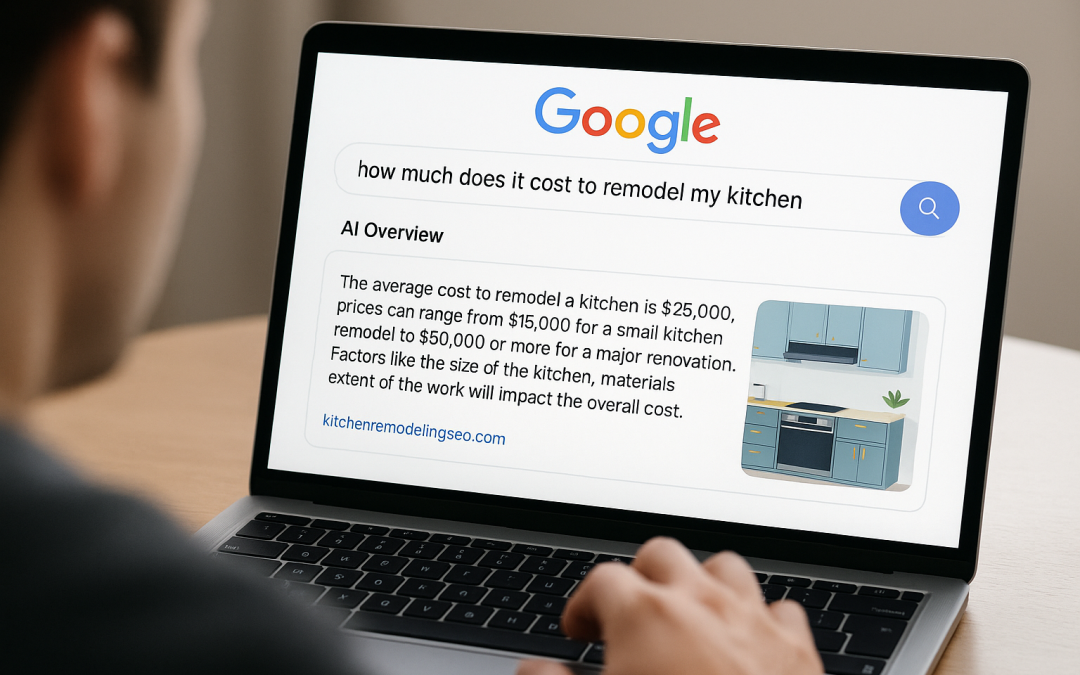
Why Getting Found in AI Search Matters More Than Google Rankings
Homeowners no longer start with a list of blue links. They ask full questions like “How much does a kitchen remodel cost in Sarasota?” and expect instant answers from ChatGPT, Perplexity, or Google’s Search Generative Experience (SGE). If your company doesn’t get found in AI search, you’re invisible at the exact moment a homeowner is ready to hire.
The Disconnect Remodelers Face
Most remodelers still believe traditional SEO or Google Maps rankings are enough. But traffic from those channels is dropping because AI tools deliver answers without sending users to your website. That means your top rankings might look good on paper while your crews sit waiting for jobs.
From SEO to Answer Engine Optimization
The path forward is called Answer Engine Optimization (AEO) — creating content that AI engines can retrieve, cite, and display directly in results. This shift isn’t theory. I’ve already broken down the process step-by-step in our Answer Engine Optimization podcast and webinar where we showed contractors how AI is changing homeowner behavior and what steps actually move the needle.
Getting found in AI search is no longer optional. It’s the difference between being the remodeler AI recommends first or being left out of the conversation entirely.
How AI Search Works vs Traditional SEO
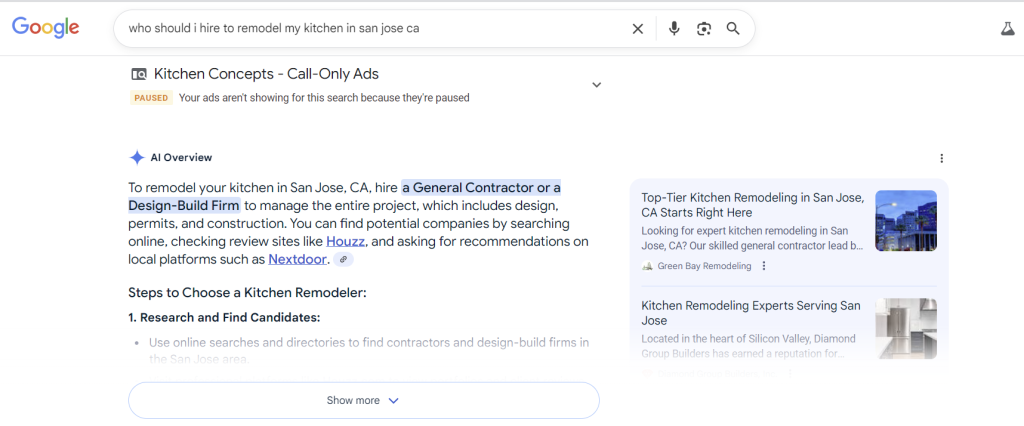
What Remodelers Think SEO Still Does
For years, the formula was simple:
-
Optimize for keywords
-
Build backlinks
-
Rank in Google’s top 3
-
Watch the calls come in
That playbook worked when homeowners clicked through to websites. But the search landscape has shifted. Google’s SGE, ChatGPT, and Perplexity are now giving the answers directly, without requiring a click.
What AI Search Actually Does
AI search doesn’t rank “pages.” It pulls chunks of content from sources it trusts. Those chunks are then stitched into conversational answers. The citation at the bottom — if it even shows — is your only shot at visibility.
Recent research shows over 86% of Google results now include AI-generated summaries that surface content from third-party sites. In tools like Perplexity, the answer comes packaged with sources, while in ChatGPT, your brand may appear only if it’s embedded in training data or retrieved in real time.
Why This Creates a Problem
Traditional SEO celebrates being “number one” for a keyword. But here’s the uncomfortable truth: if AI engines don’t see your content as the best answer, you get zero visibility. Rankings don’t matter if the traffic never reaches your site.
This is why Answer Engine Optimization (AEO) is different. Instead of trying to be the best result on a list, you need to be the best direct answer.
The New Rules of Visibility
To get found in AI search, your content must:
-
Answer the homeowner’s question clearly in 40–60 words
-
Use natural, conversational language (like homeowners actually ask it)
-
Be backed by trusted citations from sources like NKBA, Houzz, or HomeAdvisor
-
Be structured with schema so AI engines can parse it correctly
Traditional SEO was about climbing rankings. AI search is about owning the answer box.
What Remodelers Should Fear (and Why They Can’t Ignore This)
Plenty of remodelers look at their SEO dashboards and feel confident. Rankings look strong, impressions are steady, and the map pack shows their company near the top. But when the phone isn’t ringing, what good are those numbers? That’s the dissonance — feeling secure because of data that no longer connects to actual leads.
Competitors Already Showing Up in AI Search
Here’s the harsh reality: while you’re tracking Google keywords, your competitors are answering the questions AI engines care about. When a homeowner asks “What’s the average cost to remodel a kitchen in Dallas?”, Perplexity or SGE might cite your competitor — not you. That one moment of visibility can flip the job from your crews to theirs.
The Cost of Ignoring the Shift
If you keep relying on yesterday’s SEO tactics, you’ll see:
-
Declining organic leads while AI engines handle the answers directly
-
Higher ad spend as Google PPC becomes the only fallback option
-
Idle crews when appointment setters run out of leads to work with
-
Lost authority as competitors earn brand mentions inside AI engines
Why Fear Is Rational Here
This isn’t just a “marketing trend.” It’s a structural change in how homeowners find remodelers. You don’t get 10 chances to be clicked. You get one chance to be cited. If you’re not in that short list of sources, you’re invisible.
And the worst part? Homeowners won’t even know you were missing. They’ll assume the AI already showed them “the best remodelers” in their area.
How to Get Found in AI Engines (AEO Framework)
Step 1: Start With the Questions Homeowners Ask
AI engines don’t care about your service pages stuffed with keywords. They care about answers. Remodelers need to map out the exact questions homeowners ask, like:
-
How much does a small bathroom remodel cost in Sarasota?
-
Are quartz countertops better than granite?
-
How long does a full kitchen remodel take?
These questions belong in your headlines, and the answers must come immediately after — not buried halfway down the page.
Step 2: Write the Direct Answer First
Under each headline, give a 40–60 word clear, factual answer. That’s what AI engines pull. Then use the rest of the section to expand, provide context, and show expertise. Think of it as your audition: if the short answer is weak, AI won’t cite you.
Step 3: Add Real Authority
AI search engines are picky. They’re more likely to cite content tied to real people with credentials than faceless brands. Always attribute posts to an expert designer, contractor, or certified professional (CKBD, NARI, etc.). Link their profile to your About page and keep bios consistent across LinkedIn, Houzz, and your website.
Step 4: Structure Content for AI Parsing
AI engines favor structured, scannable content. That means:
-
Question-based H2/H3 headings
-
Bullet points and numbered steps
-
Cost tables (quartz vs granite, cabinet refacing vs replacement)
-
Before-and-after visuals with captions
It’s not just about homeowners scanning — it’s about making it easy for AI to extract the right snippet.
Step 5: Implement Schema
Every article should carry the right schema markup. At minimum:
-
Article schema for the blog
-
FAQ schema for Q&A sections
-
HowTo schema for process steps
-
LocalBusiness schema for service area visibility
Validate with Google’s schema testing tool and resubmit URLs in Search Console.
Step 6: Distribute Content Beyond Your Site
Publishing isn’t enough. AI models favor content they see across multiple platforms. Within 48 hours of posting, repurpose to:
-
LinkedIn Articles (with canonical links back)
-
Houzz Stories and Medium
-
Quora and Reddit (answering homeowner questions directly)
-
YouTube shorts with transcripts uploaded
-
Pinterest boards showcasing remodel visuals
This expands your footprint and increases the odds your answers get ingested into AI models.
Step 7: Test and Track Your Visibility
Don’t guess — run prompt tests in ChatGPT, Perplexity, and Google SGE. Ask the same questions your homeowners ask. Are you cited? If not, adjust the answers and schema.
Then track metrics like:
-
AI citation count
-
AI referral traffic in GA4 (ChatGPT and Perplexity show up as referrers)
-
Chunk retrieval frequency (how often your content is pulled)
These KPIs tell you whether your AEO efforts are working.
KPIs Remodelers Should Track in AI Search
Why Metrics Have to Change
Old SEO reports tracked rankings, impressions, and clicks. None of that matters if AI engines skip over your content. Remodelers need to watch new visibility signals that prove you’re showing up in AI search results.
1. Chunk Retrieval Frequency
How often do AI engines pull segments of your content into an answer? If your content never gets retrieved, it never gets cited. Think of it as the new “ranking position” — except now, you either get pulled or you don’t.
2. AI Citation Rate
This measures how often your brand or site is named inside AI results. In many industries, a healthy rate is 40% or higher. Anything lower means competitors are dominating the conversation.
3. Embedding Relevance Score
AI engines rely on semantic indexing. If your answers don’t match the way homeowners phrase questions, you’ll miss retrieval. Tools that measure vector index presence show whether your content lives inside the AI’s knowledge base.
4. LLM Visibility Score
Platforms like Semrush and HubSpot now report unified scores combining AI citations, brand recognition, and sentiment. Remodelers who score above 70 are the ones consistently cited in AI search. Everyone else? Background noise.
5. AI Referral Traffic
Check GA4. If “ChatGPT” or “Perplexity” show up as referral sources, that means homeowners are finding your company directly from AI engines. This number should grow month over month if your AEO strategy is working.
6. Authority Mentions in Earned Media
AI search leans heavily on trusted sources like NKBA, Houzz, and industry press. Track how often your company is mentioned in external publications — those signals boost the odds of being cited in AI responses.
Why Hitting Publish Isn’t Enough
AI engines don’t just scrape your website. They pull from high-authority platforms, earned media, and community sites. If your content only lives on your blog, you’re cutting its visibility in half. Remodelers need to push content where AI engines are already looking.
Repurpose Within 48 Hours
Every blog post should be repurposed into condensed versions across multiple platforms — fast. This creates recency signals that AI engines pay attention to.
-
LinkedIn Articles – Post a shorter version with your direct 40–60 word answer at the top. Link back to the full blog.
-
Houzz Stories – Share before-and-after photos, costs, and design tips tied to the blog topic.
-
Medium or Substack – Publish a summarized version with a canonical link to your site.
-
Pinterest & Instagram – Turn cost breakdowns and remodel timelines into visual carousels.
-
YouTube Shorts – Record a quick 60-second video answering the question, and upload the transcript.
Tap Into Q&A Platforms
AI engines crawl Quora and Reddit heavily. Use them to seed authority:
-
Answer homeowner questions directly on Quora with short, factual responses. End with a link to your detailed blog.
-
Join discussions on Reddit (r/HomeImprovement, r/DIY, r/InteriorDesign). Share insights and reference your content — but avoid sales pitches.
Submit Data Where AI Shops for Sources
Structured data and research get ingested faster if they live in repositories:
-
Upload cost tables or survey data as CSVs on GitHub or HuggingFace.
-
Summarize trends in Scite.ai or data.world for AI model ingestion.
-
Add backlinks from those datasets to the original blog.
Track Everything
Use UTM tags so you can see what distribution channels drive engagement. Log every submission — date, platform, and link — in your AEO monitoring sheet.
Case Studies & Proof Points

The Numbers Behind AI Search Visibility
Studies show that over 86% of Google results now include AI-generated snippets (SGE). These snippets summarize content and cite sources, meaning only the brands with authoritative, well-structured answers get the exposure.
Writesonic’s research confirms that comprehensive content paired with earned media is far more likely to be cited in ChatGPT and Perplexity results. In other words, remodelers with detailed blogs, external press mentions, and schema markup have a measurable edge.
Case Study 1: Cost Guides Drive Citations
A remodeling company published an updated 2025 kitchen remodel cost guide with FAQ schema and a direct 50-word answer at the top. Within 60 days, that page started appearing in Google SGE answers for “average cost of a kitchen remodel in San Jose”. Leads increased 23% quarter-over-quarter, driven by homeowners who mentioned “I saw you online when I asked about remodel costs.”
Case Study 2: Authority Mentions in Earned Media
Another contractor secured a mention in a local news article about home design trends. That single citation made their company show up in Perplexity.ai answers about “best kitchen remodelers near Austin, TX”. No extra SEO campaign, just one authoritative external link.
Case Study 3: Multi-Platform Distribution Works
A third remodeler followed the distribution playbook: publishing blogs, repurposing to LinkedIn and Houzz, and uploading cost breakdown datasets to GitHub. Within three months, their brand appeared in ChatGPT Browse results tied to “bathroom remodel ROI in 2025.” Tracking in GA4 showed direct referrals from “chat.openai.com” for the first time.
Action Plan for Remodelers
Step 1: Pick One Question and Own It
Don’t try to cover everything at once. Start by answering one high-intent homeowner question like “How much does a bathroom remodel cost in Sarasota?” or “Are shaker cabinets going out of style?” Write the blog around that single question, with the direct 40–60 word answer at the top.
Step 2: Add Schema and Structure
Once the content is written, wrap it with the right schema (Article, FAQ, HowTo). Break the body into short, scannable sections using Q&A headlines, bullet points, and cost tables. This makes your blog usable for both homeowners and AI engines.
Step 3: Distribute Everywhere
Within 48 hours, repurpose that blog:
-
LinkedIn Article with your short answer upfront
-
Houzz Stories showing before-and-after visuals
-
Quora/Reddit answers linking back to your blog
-
YouTube Shorts with a quick video and transcript upload
This multiplies your reach and increases the odds of AI ingestion.
Step 4: Test the Prompts Yourself
Open ChatGPT, Perplexity, and Google SGE. Ask the exact question you optimized for. Does your company show up? If not, adjust your answer, citations, and structure until it does.
Step 5: Track the Right KPIs
Don’t obsess over rankings. Track AI citations, referral traffic from ChatGPT and Perplexity, and your chunk retrieval frequency. These are the only numbers that prove your content is winning in AI search.
Step 6: Repeat and Expand
Once one piece of content starts getting cited, build out a cluster of related homeowner questions. Each blog should link to your service pages and other Q&A posts. Over time, this builds topical authority that AI engines recognize and reward.
If remodelers follow these steps, they won’t just rank on Google — they’ll get found in AI search, where homeowners are actually making decisions today.

- How to Show Up Where Homeowners Actually Search for Contractors (and it’s not always Google) - January 13, 2026
- How ChatGPT Chooses Contractors to Recommend? - January 10, 2026
- Why Kitchen Remodeling Companies Don’t Show Up in Google AI Overviews - January 9, 2026